Living longer WILL make you a billionaire
How would your life change if you got a $10 million trust fund before turning 25?
Or to put it slightly differently: while the majority of your life is still ahead of you?
There is still a way for many of us to live in this abundant future. However, it takes conscious effort to build your life and finances for a healthy, multi-century existence. It’s how I shape my life decisions.
Imagine being 75 in your 30 year old body but with tens of millions in the bank.

And then continuing on that trajectory through 150, 200, and 300.
It’s a financial cliche that investing $1/day for 60 years makes you a millionaire (ignore the returns assumption for a minute).
But have you thought about what happens if you don’t die at 85 but continue living happily and healthily for hundreds of years?
A life this long would hold many interesting careers, long idyllic periods with family, and projects whose natural timescale can be decades (or centuries).
It also does away with the assumptions:
-
That we only have 40-60 years to invest
-
After that, we are forced to stop working. For most people, that means spending their invested capital (not just its returns!) as it hasn’t had enough time to grow for its returns to support their lifestyle
40 years is not enough time to see the true value of financial compounding.
Look at when the net worth curve really starts lifting off.
Just when compounding starts to work its magic and snowball our investments into true wealth, we die.

And so, our financial planning assumes a fixed life. The first 20 years are spent on education, our careers and families are in the middle, and retirement sits at the end before death.
An open-ended healthy life changes this assumption. The monthly investment needed to become a billionaire is VERY SMALL (think $500) when it can compound over very long periods.
Given enough time, the returns on that small monthly investment become greater than the amount saved every month. At some point, the return is large enough to cover annual spending.
If humans lived for centuries instead of decades, becoming extraordinarily wealthy would be inevitable for everyone because our investments would compound over substantially longer periods. $500 invested at 5% every month until you are 200 accumulates to $1 billion. The same amount invested until the current retirement age, accumulates to just $750K.
Read the bold text again because it’s non-obvious.
Work would still continue but it would be chosen for interest and fulfilment. It would no longer be the price of survival.
We are so close to measuring life in centuries, so don’t die now
I am convinced that our generations will be the first to experience life in centuries, not decades.
This belief stems from the relatively simple concept of achieving longevity escape velocity.
Longevity escape velocity will be achieved when we can repair all ageing damage faster than it is incurred naturally. In some areas (skin, joints, eyes, certain organs) and wealth pockets (celebrities!), this is already happening.
Aubrey de Grey described this threshold in a 2004 paper in PLOS Biology. The central claim is that an extraordinarily long life would emerge from a chain of improvements, with each treatment extending the runway for the next.
If Vera Wang (77) isn’t enough proof that it’s desirable to reverse ageing, here are Nicole Kidman (59) and Anne Hathaway (43).
I can’t tell the difference between them now and when they were 30. In fact, I personally find them better looking and more confident now. Some media outlets might be on a witch hunt against them for not ‘looking their age’ but once anti-ageing interventions become affordable for the masses, they will be forgiven.
Put this way and combined with the wave of progress we are seeing in biology and AI, it’s only eventual that we solve ageing.
Measuring dollars in centuries is easier: time makes everyone rich
So, now that we will soon live in centuries, how do we fund these centuries?
Let’s assume someone begins investing at 20 with NO inherited wealth. They make one contribution at the end of every month and earn a constant real return.
The balance after n months Bₙ can be computed with an annuity formula that most of us learned in school:
Bₙ = c × [((1 + i)ⁿ − 1) ÷ i]
-
c is the monthly contribution, i is the monthly real return, and n are the months of compounding
-
Monthly return is derived from the annual real return as i = (1 + r)^(1/12) − 1
-
The contribution is assumed constant in real terms i.e. someone investing $50 a month today would gradually increase the nominal amount to preserve the same purchasing power of $50
Almost everyone in the developed world can invest $50/month. It’s the cost of a takeaway order. Over 40 years, growing at 5%, it’s worth less than $100K.
Over 180 years, growing at 5%, it’s worth $80 million. Thus, a retail worker can have the same net worth as Anne Hathaway, given enough time. Add another century at the same 5% return and their net worth is $10bn, the retail worker is now as rich as Michael Jordan.
Real returns hold strong over centuries
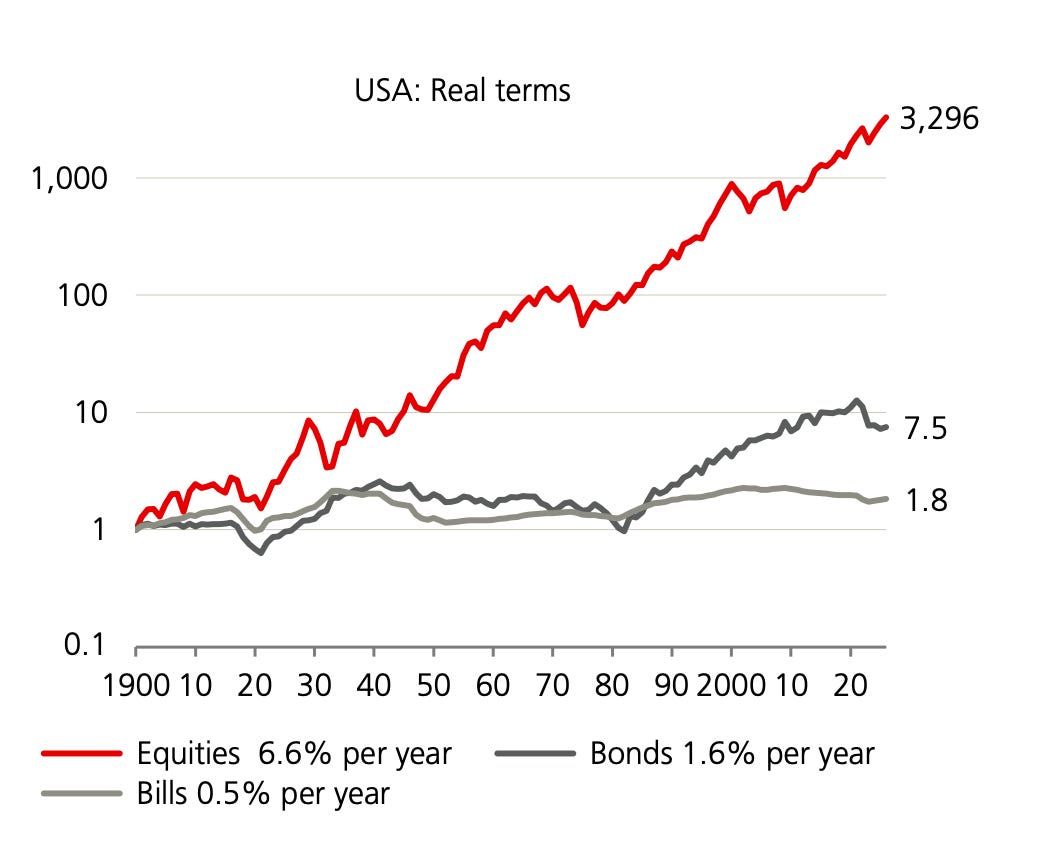
According to the UBS Global Investment Returns Yearbook 2026, US equities produced an annualised real return of 6.6% between 1900 and 2025.
That span includes:
-
Two world wars
-
The Great Depression
-
Banking collapses
-
Oil shocks and stagflation
-
The end of Bretton Woods
-
The global financial crisis
-
And a pandemic
The American result reflects the most successful large economy of the era.
Measured in today’s purchasing power, $100,000 following the U.S. stock market’s 1900–2025 returns would grow to ~$330 million, if you could only stay invested and alive, for 125 years.
The 2025 UBS Yearbook reports a more modest real return of ~3.5% for global equities since 2000.
The returns projections in this article use 3-5% for this reason.
Humans expecting to live for centuries should think like investment funds
Even though humans don’t routinely invest across centuries, financial institutions designed to exist in perpetuity do.
Yale, founded in 1701, manages a $44 billion endowment. Harvard, founded in 1636, manages nearly $57 billion.
In 2025 alone, Yale generated $4.5 billion in investment gains and Harvard generated $5.8 billion. This far exceeds their annual inflows from new endowment gifts.
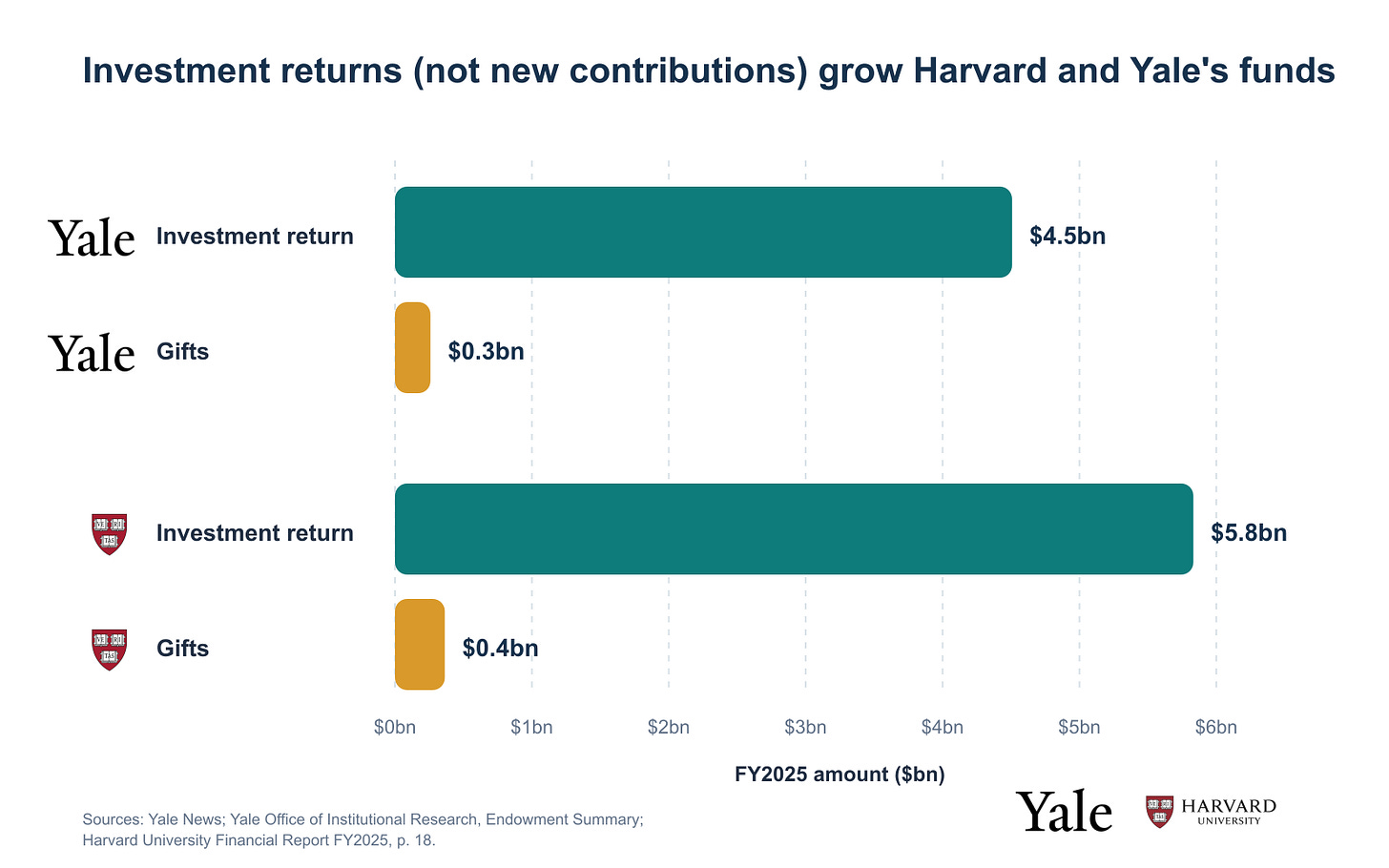
Their main source of growth is no longer new capital but the compounding of existing capital. They have achieved financial escape velocity.
Once humans routinely live for centuries, we will face the same investment problem as these perpetual institutions: converting finite annual income into a permanently compounding pool of assets to achieve financial escape velocity.
A long-lived person should do the same as perpetual funds: create productive, compounding assets, be disciplined with withdrawals especially earlier in life, and maximise the time horizon of their investments.
By 150, a personal fund will likely contain the surplus from several careers. Capital accumulated while working for a company would sit beside the proceeds of a later business exit. Eventually, investments and withdrawals will be dwarfed by capital returns.
In this framework, a prescribed retirement age and even the concept of pensions carries little economic meaning.
For the past few years, even as I have taken productive risks in my career, I have managed my personal investments under this framework so that I can achieve financial escape velocity (alongside longevity escape velocity).
Whether I was interning, working as an investment banker, or building a business, I consistently invested in productive assets (from $50 some months to $50,000 in other months) to maximise the time horizon of my investments. Until now, I haven’t and don’t expect to withdraw my productive capital to fund my lifestyle.
You will become a billionaire if you just live long enough
Someone who invests $500 a month from age 20 reaches approximately $1.02 billion by age 205 at a 5% real return. Across those 185 years, they contribute $1.11 million in today’s money. Investment growth accounts for the remaining $1.019 billion.
Let’s make the example more real.
Consider someone who starts at 20, earns $60,000 a year in today’s money, spends $54,000 and invests the remaining $6,000 through monthly contributions of $500.
The savings crossover occurs when investment returns during the last twelve months exceed the $6,000 added from income. At a 5% real return, it arrives at 34 years and 9 months when the investment principal is $129,000. The portfolio is already adding more to itself than its owner does.
The consumption crossover arrives at 67 years and nine months when the investment principal is $1.14 million. Expected annual investment gains now exceed the person’s entire $54,000 cost of living. Just the portfolio returns are now able to support the holder.
Two years later comes the income crossover. At approximately 69 years and nine months when the investment principal is $1.27 million, annual gains exceed the full $60,000 salary. Existing capital is producing about ten times as much new wealth as the person’s $6,000 annual investment.
When humans live for centuries, at this point, most of their life is still ahead of them.
This example and illustration purposefully assumes an income and saving threshold that a normal working class person can achieve.
Time solves money but you decide what to do with your time
You might spend a few years years studying ancient languages, build a company over a few decades, use a decade to start and enjoy your family, and teach your learnings over another.
Someone might train for a new job at 110 with more working years ahead of them than a university graduate has today.
Scientific projects, art, and literature could be pursued on long time horizons.
Career risk would feel different. A failed business at 90 might be followed by an apprenticeship and another attempt at 100.
Work would become increasingly self-directed. People would continue working because they enjoy what they do.
A $50 monthly investment costs the same as a weekend takeaway order. Compounded across centuries, it leads to freedom.